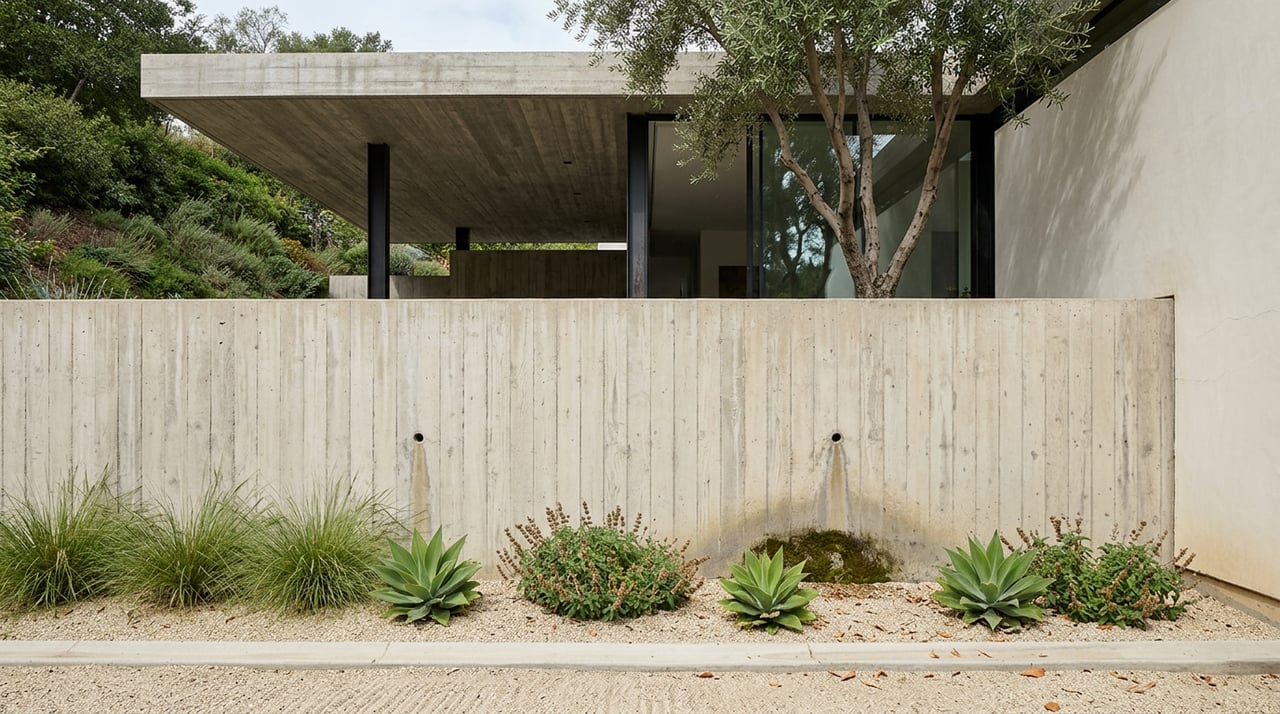
On a Sunday morning in March 2024, the Los Angeles Fire Department got a call about "hill movement" on the 9200 block of Flicker Way, deep in the Bird Streets above the Sunset Strip. By the time crews arrived, the slope behind several homes had begun to shift. No one was hurt. Three houses were red-tagged by the Department of Building and Safety before the afternoon was out, their owners locked outside their own front doors while geologists assessed what the hill would do next. About a week and a half later, elsewhere in the Hollywood Hills, a homeowner on Sunset View Drive watched a slope collapse into the kitchen of the house he'd spent more than a year building, days before he planned to move in.
Neither of those homes changed hands that week. But if they had been under contract, the sale would not have been decided by anything on a listing sheet. It would have been decided by a slope report, a fire zone designation, and an insurance underwriter's appetite for that specific parcel. That is the piece of the Hollywood Hills market that a scroll through home values does not show you: the price is rarely what slows a hillside deal down. The mechanics behind the price are.
The Slope Was Never the Point
Every serious hillside conversation eventually gets to the Baseline Hillside Ordinance, and most buyers hear about it only after they have already fallen for a house. The ordinance caps how much earth you can move on a lot with a natural slope of 15 percent or greater at 500 cubic yards of cut and fill, plus 5 percent of the lot's area. That number is not a suggestion. It is the ceiling on the pool deck, the retaining wall, the flat pad for a guest house, whatever the next owner is picturing when they walk the property. A buyer who assumes a steep lot behaves like a flat one in the permit office is planning around a number that does not exist.
Layered on top of that is the soils and geology question. A geotechnical report is not automatically required to close on an existing hillside home, but it becomes mandatory the moment anyone applies for a permit on new construction or a major addition on a hillside parcel. For a buyer, ordering one during escrow is optional, not automatic, which is exactly why it gets skipped more often than it should. Done early, it tells you what the slope will actually support and gives you real leverage to negotiate price or repair credits before you remove contingencies. Done late, or not at all, it tells you nothing until something moves.
The state has mapped this risk in detail for decades. The California Geological Survey's seismic hazard zone report for the Hollywood quadrangle, which covers the Hollywood and Los Feliz hillsides along with adjoining slopes in Beverly Hills and West Hollywood, breaks the terrain down by landslide potential, liquefaction, and amplified shaking, all derived from slope gradient, rock strength, and geologic structure specific to each parcel. It is public, it is site-specific, and almost no buyer looks at it before writing an offer.
Insurance Runs on a Faster Clock Than Escrow
If the ordinance sets what you can build, insurance increasingly sets what you can afford to own. As of early 2026, roughly 41 percent of homes in Los Angeles's highest-risk zip codes were already insured through the California FAIR Plan, the state's insurer of last resort, because State Farm, Allstate, and Farmers have all pulled back or stopped writing new policies in those areas entirely. On October 15, 2026, FAIR Plan dwelling rates rise again, by an average of 29.8 percent statewide, with about half of policyholders seeing increases in the 30 to 50 percent range.
For a hillside estate in the Hollywood Hills or Bel Air, the real number that matters is not the FAIR Plan base rate. It is what sits on top of it. Basic FAIR Plan fire coverage in the most exposed hillside zones runs $5,000 to $25,000 a year on its own, and because that policy only covers fire, most owners layer a difference-in-conditions policy or move to surplus lines coverage for everything else. On a genuine luxury hillside property, that full stack of coverage can run $30,000 to $60,000 a year, a fixed cost that a lender needs bound before they will fund the loan at all.
That timing problem is the trap. Buyers who wait until after their loan contingency is removed to shop insurance sometimes discover there is no standard market left to shop. A property inside a Very High Fire Hazard Severity Zone, which covers a meaningful share of Hollywood Hills canyon and ridge parcels under current CAL FIRE mapping, triggers a Natural Hazard Disclosure at sale and narrows the carrier pool before anyone signs anything. The fix is not complicated. It just has to happen in week one of escrow, not week five.
The Number Nobody Priced In: Measure ULA
Los Angeles's transfer tax on high-value sales, commonly called Measure ULA, reset its thresholds on July 1, 2026, to $5.4 million and $10.9 million, adding a 4 to 5.5 percent tax on top of everything else at closing. In most of the city, that threshold still catches only the top sliver of the market. In the Bird Streets, it does not. A meaningful share of what sells there in a given year now clears $5.4 million as a matter of course, which means the ULA math is not a rare event for a trophy compound. It is a routine part of the closing statement for an ordinary architectural remodel above the Strip.
That is worth sitting with for a second. The tax was written with mansions in mind. In this particular zip code, it now applies to houses that would be described as comfortably upper-middle by Bird Streets standards. Sellers who price without modeling that cost, and buyers who structure offers without asking who absorbs it, are negotiating around a number that changes the math on both sides of the table.
What the Blended Median Actually Hides
Here is where the Zillow-style numbers stop being useful. As of May 2026, the tracked Hollywood Hills average home value sat at $1,953,972, down 1.3 percent over the prior year, with a median sale price of $2,106,667 and a median list price of $2,498,000. Those figures are accurate. They are also almost meaningless for anyone actually shopping in the Bird Streets, where estates list well into eight figures, because the boundary being measured stretches from modest homes near the Cahuenga Pass all the way up to $20 million-plus view properties on Blue Jay Way and Flicker Way.
A single median cannot describe a neighborhood where the grading cap, the fire zone designation, and the ULA threshold behave completely differently depending on which side of that boundary a house sits on. The number that actually predicts how a deal goes is not the median. It is whether the specific parcel clears three separate gates: what the slope will let you build, what a carrier will let you insure, and what the city will let you keep at closing.
A Few Straight Answers
Do I need a geotechnical report before I make an offer on a hillside property? It is not legally required to close on an existing home, but ordering one during your inspection period gives you leverage that is much harder to get after you have removed contingencies. If you plan any addition or major remodel, the city will require one before issuing a permit regardless.
Does every Hollywood Hills sale trigger Measure ULA? No. It only applies above the $5.4 million threshold set on July 1, 2026, but that threshold is common enough in the Bird Streets and along Sunset Plaza that it belongs in your offer strategy from the start, not as an afterthought at closing.
Can an insurance problem actually stop a sale? Yes, if it surfaces late. Lenders require bound coverage before funding, and if a property's fire zone status limits you to the FAIR Plan plus a surplus lines wrap, that quote needs to be in hand before you remove your loan contingency, not after.
None of this makes hillside real estate here a bad bet. It makes it a different kind of transaction than the flats, one where the slope, the ordinance, and the insurance market decide the terms as much as the buyer and seller do. Getting those three questions answered early is the difference between a deal that closes on schedule and one that stalls in week five over something that should have been resolved in week one.
If you are evaluating a hillside property in the Bird Streets, Laurel Canyon, or anywhere above the Strip, Harris & Partners can walk you through the grading, insurance, and tax exposure specific to that parcel before you write an offer. Request a confidential consultation to start.
